
In collaboration with:
American Geriatrics Society

The 28 virtual patient cases in Aquifer Geriatrics provide the AGS National Online Curriculum for medical and health professions students.
Overview
Aquifer Geriatrics helps students learn the principles of geriatric medicine and integrate these principles into the care of their patients. With a range of cases spanning many specialties, the content stands alone as an educational tool or enriches an existing curriculum.
As life spans increase, it becomes even more vital to understand the kind of health care our patients need as they age. It’s critical for healthcare providers to understand the unique health circumstances and preferences that come with aging so they can work in collaboration with one another—especially important given that more than half of older Americans are managing two or more chronic conditions.
Publications
In Academic Medicine: Journal of the Association of American Medical Colleges, “Updated Geriatrics Competencies for Graduating Medical Students: Training Physicians to Provide Age-Friendly Care” presents the updated competencies in geriatrics for graduating medical students, framed by the Geriatrics 5Ms (Mind, Mobility, Medications, Multicomplexity, and What Matters Most).
In the Journal of the American Geriatrics Society (JAGS), “Introducing Aquifer Geriatrics, the American Geriatrics Society National Online Curriculum”, discusses the development of this course, highlights best practices to incorporate cases in a variety of teaching settings, and describes teaching methods that utilize the curriculum to create a robust experience for learners.
An accompanying editorial also published in JAGS states that Aquifer Geriatrics is “helping to fill the gap that is left by the shortage of geriatrics educators” and prepares the field to “play the long game,” thanks to innovative solutions to education.
Course Details
- Created for educators, by educators, as the American Geriatrics Society national online curriculum for medical and health professions students
- Access to Aquifer Calibrate: Transformative Assessments for Clinical Learning Mastery, our innovative system for formative assessment, available with subscription
- Available for institutional subscription or for direct purchase by individual subscribers
- Students discover the physiological, psychological, and functional changes that occur with aging and the multifaceted aspects of geriatric care
- Cases are function-focused and incorporate common diseases in older adults
- Proven pedagogy that standardizes experiences—overcoming geography, seasonality, and accessibility
- Evidence-based, peer-reviewed, and continuously updated content
- A wealth of source material—including embedded assessment questions and full references—in each case
- Delivered via the Aqueduct teaching and learning platform, which includes user management tools, easy reporting on student progress and course usage, plus tools for creating custom courses to match a specific curriculum
Our cases were developed collaboratively with authors from 35 different institutions. Topics covered include medication management, dementia, osteoarthritis, pain management, hospitalization, and many more.
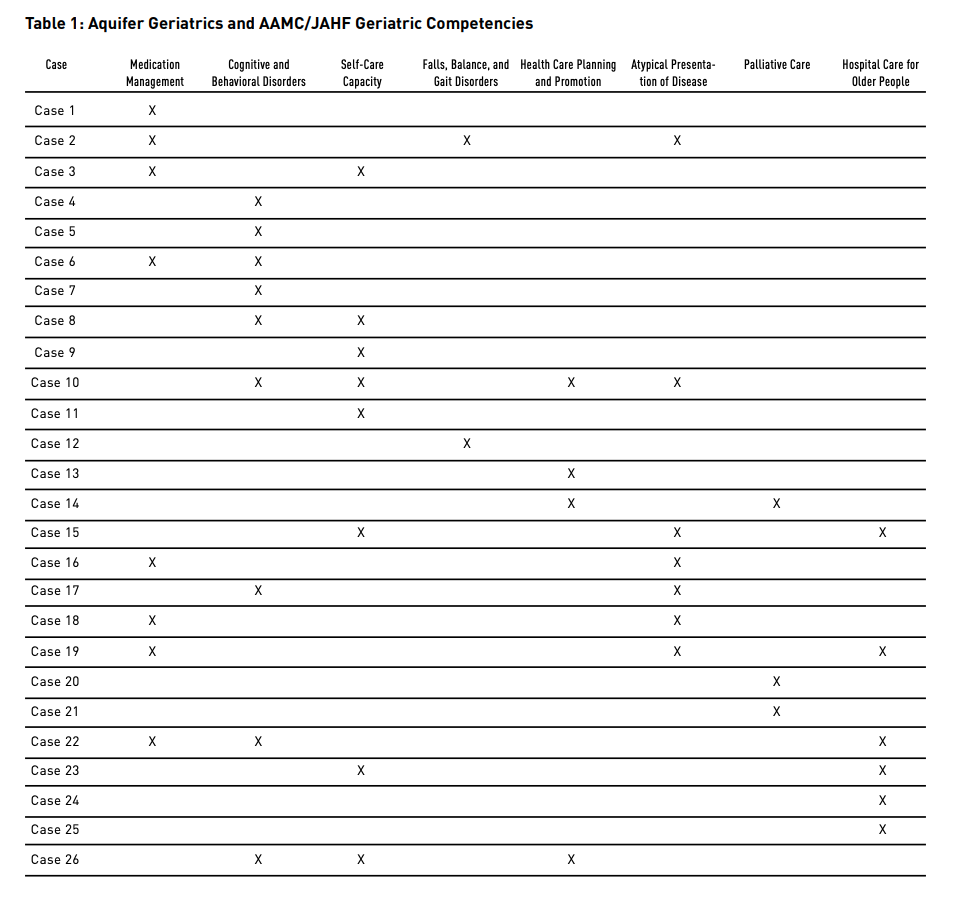
The Aquifer Geriatrics cases have been mapped to the AAMC/JAHF Minimum Geriatrics Competencies for Medical Students.
Click on the image below to enlarge the table.
The course is ideal for use within a geriatrics, internal medicine, or family medicine clerkship, or as a baseline boot camp for a Geriatrics resident or fellow. Individual cases can be integrated into another clerkship or clinical training with an emphasis on neurology, psychiatry, emergency medicine, or OB/GYN. With Aqueduct, combining these cases with another course to build a custom curriculum is easy.
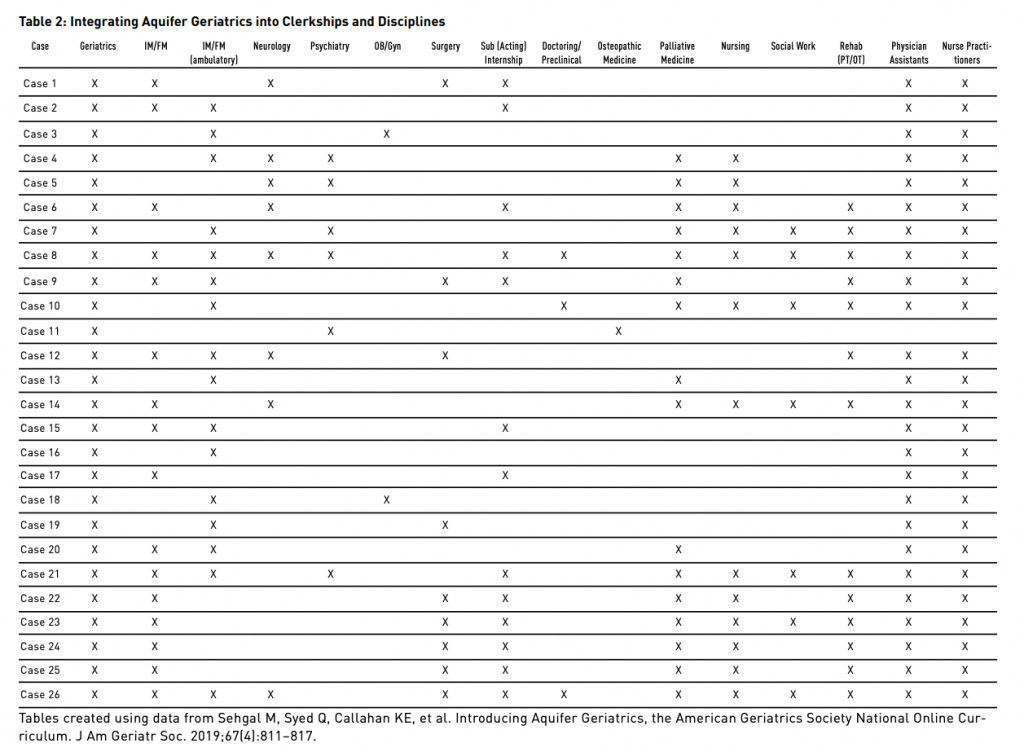
Since many institutions do not have dedicated Geriatric Medicine clerkships, the cases have been further categorized and matched to medical specialties and curricula to provide a framework for assigning cases across various clerkships, like Neurology, Psychiatry, and Surgery.
Click on the image below to enlarge the table.
Geriatrics 01: 85-year-old using anticoagulants
Geriatrics 02: 85-year-old with hypoglycemia
Geriatrics 03: 91-year-old with urinary incontinence
Geriatrics 04: 85-year-old with dementia
Geriatrics 05: 79-year-old with agitation
Geriatrics 06: 85-year-old with delirium
Geriatrics 07: 78-year-old with depression
Geriatrics 08: 86-year-old and decisional capacity in the context of elder abuse
Geriatrics 09: 82-year-old and assessment of functional status and home safety
Geriatrics 10: 72-year-old with weight loss; addressing sexuality in older adults
Geriatrics 11: 75-year-old with neck pain (osteopathic approach)
Geriatrics 12: 78-year-old with recent falls
Geriatrics 13: 75-year-old and 80-year-old patients, prognosis and screening for older adults
Geriatrics 14: 88-year-old with dementia and feeding issues
Geriatrics 15: 75-year-old with abdominal pain
Geriatrics 16: 87-year-old with low back pain
Geriatrics 17: 86-year-old with nursing home-acquired pneumonia
Geriatrics 18: 83-year-old with urinary tract symptoms
Geriatrics 19: 70-year-old with urinary concerns
Geriatrics 20: 79-year-old with severe pain and low health literacy
Geriatrics 21: 70-year-old with symptomatic end-stage COPD: An Interprofessional Case
Geriatrics 22: 74-year-old and hazards of hospitalization: Geriatric patient safety in the acute care setting
Geriatrics 23: 70-year-old and hazards of hospitalization: Transitions of care and discharge planning for geriatric inpatients
Geriatrics 24: 78-year-old with pressure injuries
Geriatrics 25: 92-year-old and restraints
Geriatrics 26: 78-year-old and cultural humility in geriatric care
Geriatrics 27: Advance care planning
Geriatrics 28: Frailty in three patients
From Our Cases
User Stories
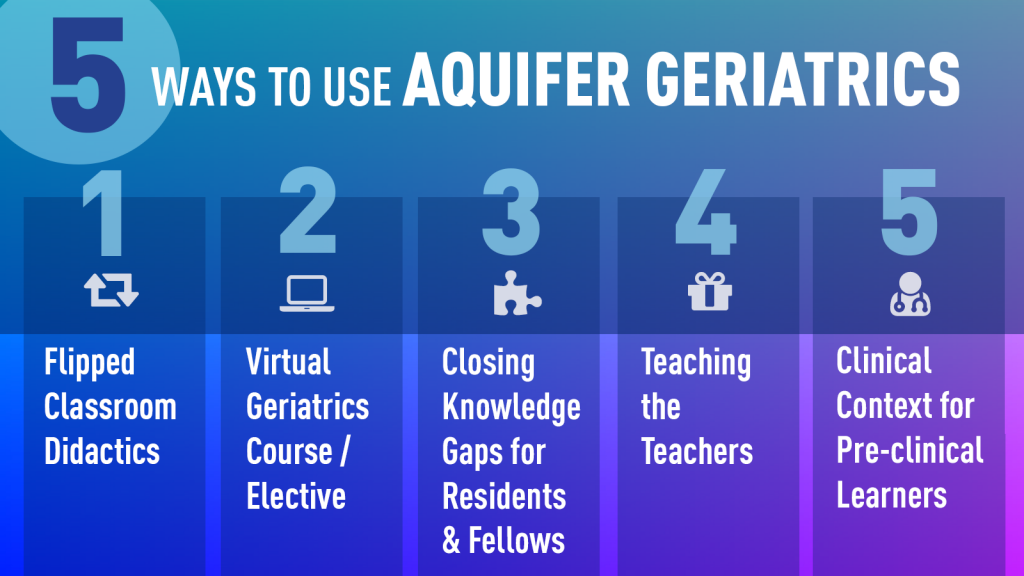
Learn how Aquifer Geriatrics can benefit medical students, residents, fellows, and faculty in your program:

On-Demand Webinar
Best Practices for Using Aquifer Geriatrics Across the Curriculum